What Inspectors Look For: How Staff Canteens and Commercial Kitchens Earn a 5-Star Food Hygiene Rating
Posted on October 22, 2026
TL;DR – the short answer
To get a 5-star (“very good”) food hygiene rating, a business needs a total inspection score of 0–15 with no individual score above 5. The scores cover three areas: how hygienically food is handled, the physical condition and cleanliness of the premises, and confidence in management (your food safety systems and records). Most lost points come from things you can control: cleaning standards, maintenance and paperwork.
Whether it’s a staff canteen in a Telford manufacturing plant, a café inside a hospital, or a kitchen in a care home, the food hygiene rating on the door says a lot. Under the Food Standards Agency (FSA) Food Hygiene Rating Scheme (FHRS), local authority officers inspect food businesses in England, Wales and Northern Ireland and rate them from 0 (“urgent improvement necessary”) to 5 (“very good”) [1].
The FSA is clear that all businesses should be able to achieve the top rating[1]. This guide explains how inspectors score you and the cleaning and management habits that turn a 3 or 4 into a 5, and keep it there.
72%
of food businesses in England displayed a hygiene rating sticker in 2024, up from 55% in 2017
Source: FSA, 2025
89%
of English businesses rated 4 or below made changes to improve their next rating
Source: FSA, 2025
86%
of English businesses think mandatory display of ratings would be a good thing
Source: FSA, 2025
What does a food hygiene inspector check?
According to the FSA, the inspecting officer checks three elements[1]:
Elements as described by the Food Standards Agency. Issue examples are common findings, not an official list.
Element
What it covers
Typical cleaning and maintenance issues
1. Hygienic food handling
How food is prepared, cooked, reheated, cooled and stored
Cross-contamination between raw and ready-to-eat food, dirty utensils, poor temperature control
2. Physical condition of the premises
Cleanliness, layout, lighting, ventilation, pest control and other facilities
Grease on canopies and walls, dirty floors and drains, damaged surfaces, blocked hand-wash basins, signs of pests
3. Confidence in management
How the business manages and records what it does to keep food safe
Missing cleaning schedules, gaps in temperature logs, no evidence of staff training
How is a food hygiene rating calculated?
Each element gets a numerical score, and lower is better. The scores are added up, and the total is matched to a rating band. Crucially, there is also an “additional scoring factor”: your worst single element limits your rating, however good the other two are [2].
Score bands from the FHRS scoring table published by Derby City Council, based on the intervention rating scheme in the Food Law Code of Practice.
Total score
Additional condition
Rating
0–15
No individual score greater than 5
5 – Very good
20
No individual score greater than 10
4 – Good
25–30
No individual score greater than 10
3 – Generally satisfactory
35–40
No individual score greater than 15
2 – Improvement necessary
45–50
No individual score greater than 20
1 – Major improvement necessary
Over 50
–
0 – Urgent improvement necessary
Why this matters for cleaning: a spotless food-handling performance can’t make up for a greasy extraction canopy or a damaged floor. If the “physical condition” score is above 5, a 5 rating is impossible.
How often are food businesses inspected?
Inspection frequency depends on risk. The FSA says intervals range from every six months for the highest-risk businesses to every two years for lower-risk ones, and some very low-risk businesses may wait longer [1]. In practice, an unannounced visit can happen on any day, so the aim is to be “inspection ready” every day rather than preparing for one.
Do you have to display your food hygiene rating?
It depends on where you are. Display is a legal requirement in Wales and Northern Ireland and voluntary in England [1]. Even so, display in England is rising. The FSA’s 2024 audit found that 72% of English businesses displayed a sticker, up from 55% in 2017. In Wales and Northern Ireland the figures were 94% and 90% [3]. The same survey found that 86% of English businesses felt it would be a good thing if display became mandatory [3].
What do businesses change to improve their rating?
The FSA survey asked businesses rated 4 or below what they did next. Around nine in ten (89%) in England said they changed how they work to improve at the next inspection. The most common changes were repairs and improvement works (20%–29% by nation), better documentation and record keeping (17%–21%), fixing structural issues, and buying extra equipment [3]. Each of those maps directly onto one of the inspector’s three elements.
How to get a 5 star food hygiene rating: a practical checklist
Use this list to stress-test your kitchen against all three elements. It’s based on FSA guidance and on what we see when kitchens call us in after a disappointing score.
Five-star readiness checklist
✓Written cleaning schedule: list every area, the method, the chemical, the frequency and who signs it off, including high-level and behind-equipment areas, not only worktops.
✓Safe system in writing: use the FSA’s Safer Food, Better Business (SFBB) pack or an equivalent HACCP-based system, and keep it up to date [4].
✓Temperature records: log fridge and hot-holding temperatures daily and record what you did when a reading was out of range.
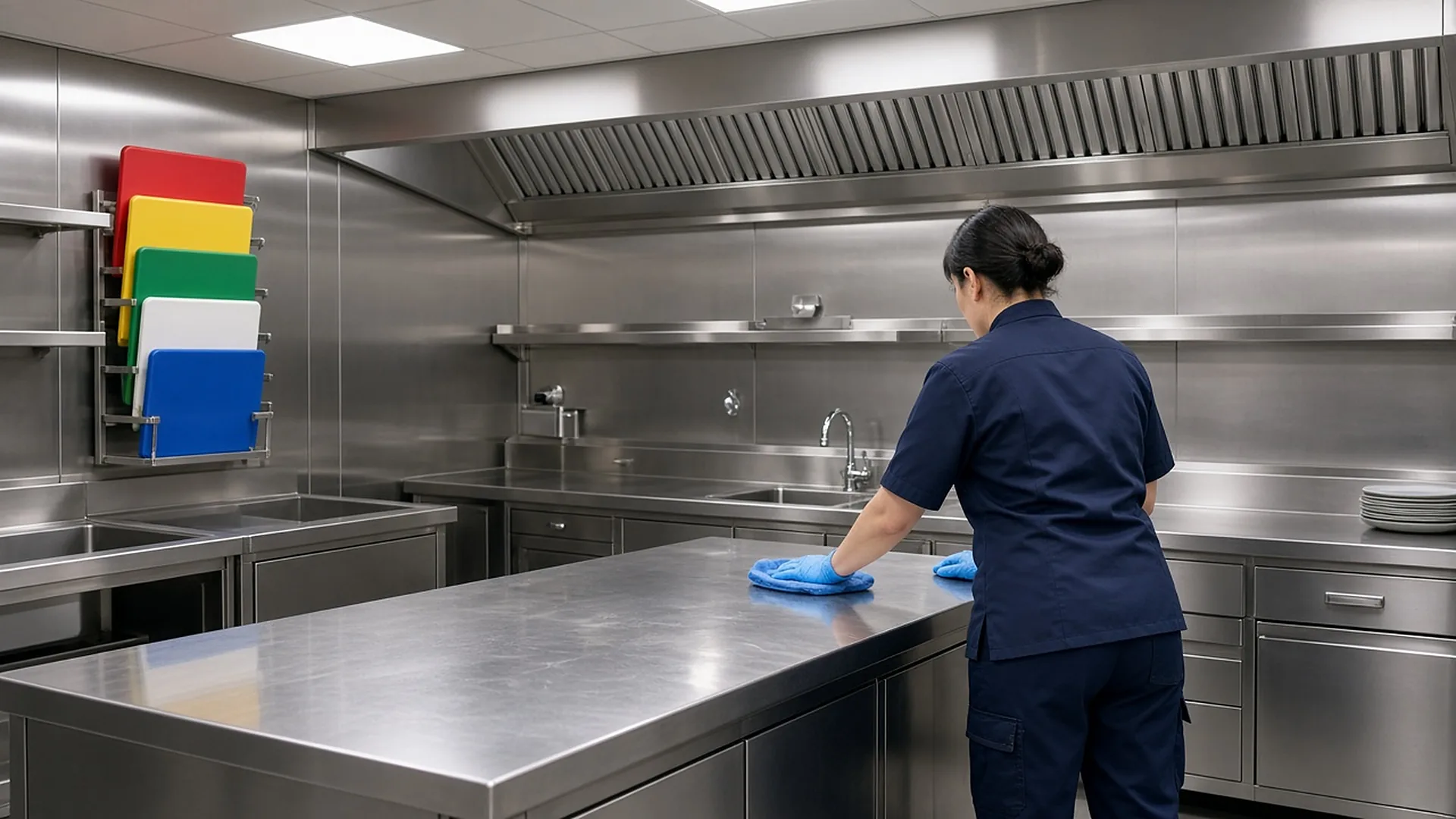
✓Separation: use colour-coded boards, cloths and utensils for raw and ready-to-eat food, and store raw meat below ready-to-eat food.
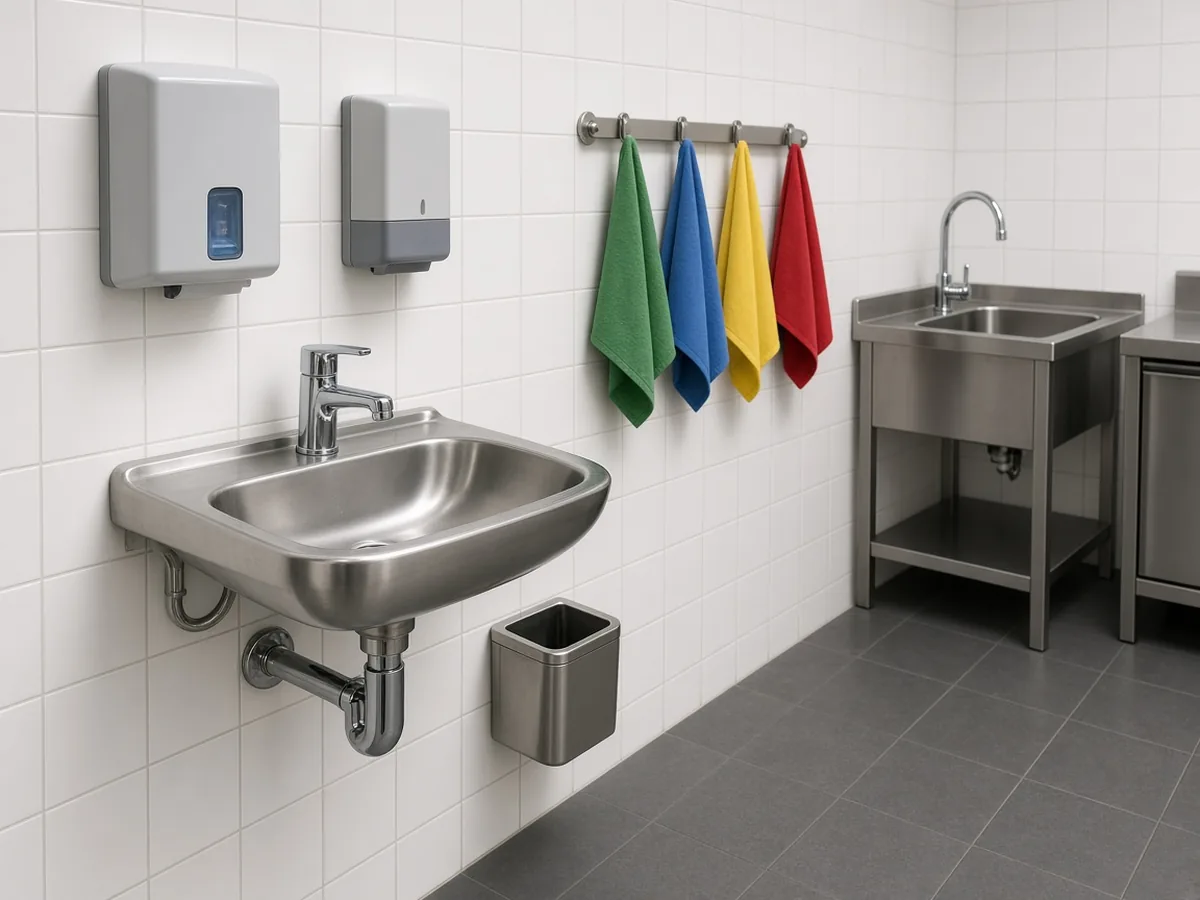
✓Hand-wash basins: keep them used only for hand washing, stocked with soap and paper towels, and never blocked by equipment.
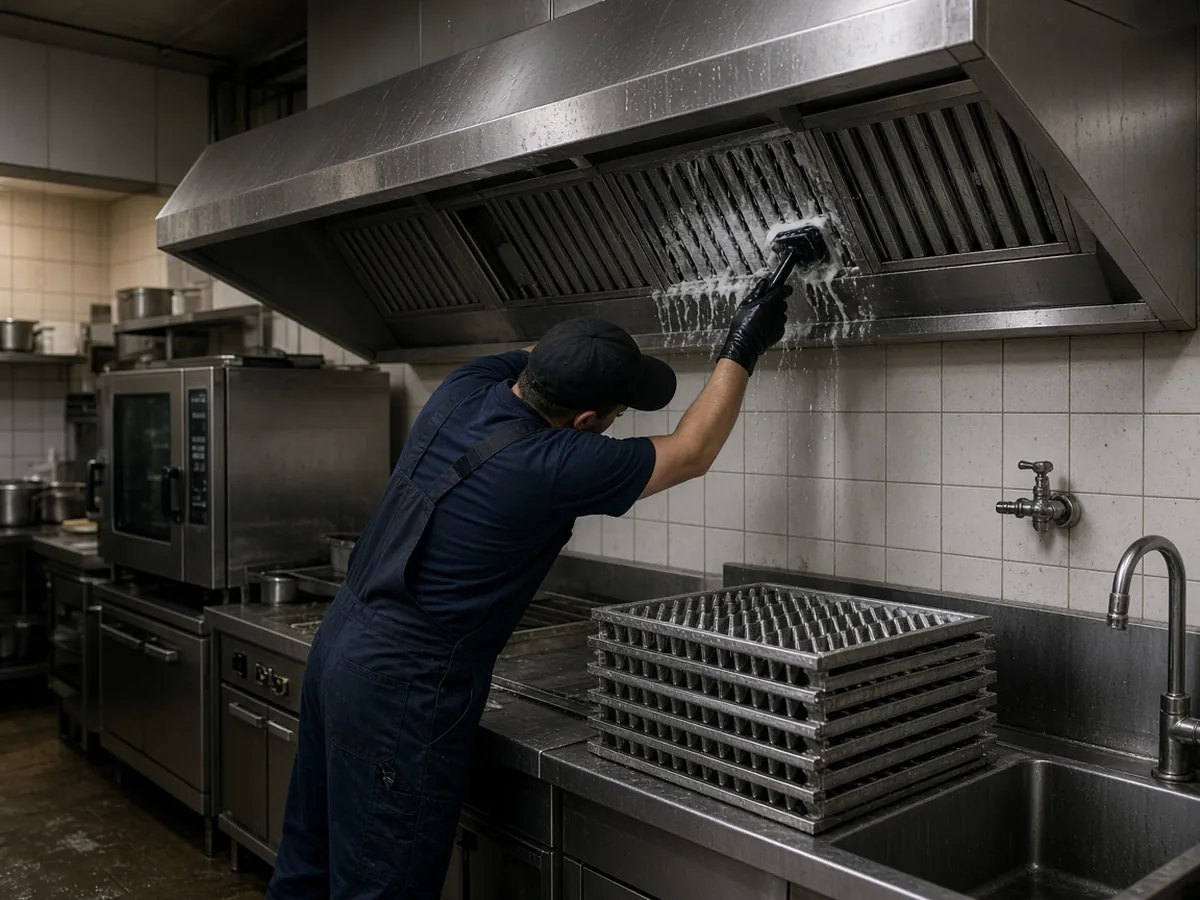
✓Extraction and grease: clean canopy filters regularly and arrange periodic specialist cleaning of the ductwork.
✓Floors, walls and drains: make sure surfaces are intact, cleanable and visibly clean, especially corners, coving and under equipment.
✓Pest proofing: keep fly screens intact, door seals sound and contract pest-control records on file.
✓Training records: keep evidence that every food handler has been trained and supervised in proportion to their role.
Why a deep clean can lift your “premises” score
Daily cleaning keeps visible surfaces clean, but inspectors look up, behind and underneath. Grease builds up in canopies, on the back of cooking ranges and in floor drains over months, and that is exactly what moves a structure score from 0 or 5 to 10 or more. A periodic specialist kitchen clean, timed before your expected inspection window, resets those hidden areas and gives you a dated record to show the officer.
Floors deserve the same attention. Kitchen floors that are worn, porous or ingrained with grease are hard to clean, can harbour bacteria and create slip risks. Periodic machine scrubbing and floor restoration keeps them in a condition an inspector will recognise as cleanable.
What if you disagree with your rating?
The FSA explains that businesses can appeal a rating they think is unfair, and can ask for a re-visit once improvements have been made. Each route comes with forms and time limits set out on the FSA’s FHRS guidance for businesses [1]. Before you request a re-visit, make sure the officer’s report has been fully addressed and that you have evidence such as dated photos, invoices and updated records.
How Prime Facility Services helps kitchens get ready for a food hygiene inspection
For over two decades, our teams have deep cleaned kitchens ranging from small independent restaurants to large chain hotels, pubs, bars and industrial kitchens. Prime Facility Services is owner-managed and works from bases in Telford and Dudley, covering Shropshire, Staffordshire, the West Midlands and beyond. We are accredited to ISO 9001 and ISO 14001 (since 2010) and to Safecontractor (since 2013).
Grease and carbon residue can build up over time and lead to fire risk and cross-contamination, which is why extraction cleaning sits within our kitchen deep cleaning service. These are the services that support a good inspection result:
A deep clean of ceilings, floors, walls and worktops, plus cookers, griddles, fryers, refrigerators and freezers. Our teams can work alongside your in-house kitchen staff.
Routine cleaning between deep cleans, delivered by trained, supervised teams and checked through digital cleaning audits.
What a pre-inspection clean can include
✓a deep clean of the kitchen, equipment and extraction, timed before an expected inspection or a requested re-visit
✓the hygiene certificate we issue after every kitchen deep clean, filed with your other food safety records
✓attention to the structural details an officer notices, such as wall junctions, floor edges and behind equipment
✓a routine cleaning schedule that keeps the standard up between visits
A deep clean supports the cleanliness and condition of your premises. It does not replace your food safety management system or good handling practice, which the officer scores separately.
A 5 rating needs a total score of 0–15 with no single element scoring above 5.
Inspectors score food handling, the physical condition and cleanliness of the premises, and confidence in management.
Inspections happen every six months to two years depending on risk, so stay inspection-ready every day.
In England, 72% of businesses displayed their rating in 2024 (FSA). Display is mandatory in Wales and Northern Ireland.
Hidden grease, damaged surfaces and missing records are the most common reasons kitchens miss out on a 5.
Frequently asked questions
What score do you need for a 5 star food hygiene rating?
You need a total inspection score of 0–15 with no individual element scoring more than 5. Lower scores are better.
What three things does a food hygiene inspector look at?
How hygienically food is handled; the physical condition of the premises, including cleanliness, layout, lighting, ventilation and pest control; and how the business manages and records food safety (confidence in management).
How often do food hygiene inspections happen?
The FSA says it ranges from every six months for the highest-risk businesses to every two years for lower-risk businesses. Some very low-risk premises may wait longer.
Is it a legal requirement to display a food hygiene rating?
Display is mandatory in Wales and Northern Ireland. In England it is voluntary, although the FSA’s 2024 survey found 72% of English businesses displayed a sticker.
Does cleaning affect a food hygiene rating?
Yes. Cleanliness is part of the physical condition element, and a written cleaning schedule supports the confidence in management element. Poor cleaning can cap your rating even if food handling is good.
Can you get re-inspected after improving?
Yes. The FSA explains that businesses can request a re-visit once they have made the improvements the officer asked for. There are set procedures and forms on the FSA’s guidance for businesses.
Will a professional kitchen deep clean improve my food hygiene rating?
It can help with the cleanliness and condition of the premises, which is one of the three areas the officer scores. Hygienic food handling and food safety management are assessed separately, so a clean is not a guarantee. Prime Facility Services deep cleans kitchens, equipment and extraction, and issues a hygiene certificate on completion. Call 0800 566 8894 to book.
Winter Norovirus and Flu: How to Prevent Outbreaks in the Workplace
Last winter, norovirus reports in England peaked at 627 a week in January, and flu took off in late October. Here’s how norovirus and flu spread at work, why hand gel isn’t enough, and the cleaning steps that make the biggest difference.
Daytime Cleaning and Energy Bills: Can Changing Your Cleaning Schedule Cut Building Costs?
Non-domestic electricity averaged 24.51p per kWh in Q2 2026, and lighting alone accounts for 15.5% of office electricity use. Moving cleaning into the working day can cut the hours a building runs. Here’s how to work out whether it adds up for you.
Void Turnaround Times: Why Every Day Empty Costs Housing Providers
The median social home in England now stands empty for 30 days between tenancies, up from an average of 21 days before the pandemic. Here’s what the latest government and regulator data says about void times, rent loss and demand, and where days can be won back.
National Standards of Healthcare Cleanliness 2025 Explained for GP Surgeries and Dental Practices
The National Standards of Healthcare Cleanliness 2025 replaced the 2021 version and apply to all healthcare organisations. Here’s what functional risk categories, audit target scores and star ratings mean for a GP surgery or dental practice.