National Standards of Healthcare Cleanliness 2025 Explained for GP Surgeries and Dental Practices
Posted on October 22, 2026
TL;DR – the short answer
The National Standards of Healthcare Cleanliness 2025, published by NHS England on 5 February 2025, replaced the 2021 standards and apply to all healthcare organisations. Every room is given a functional risk (FR) category from FR1 to FR6. The category sets how often it is cleaned and audited and the score it must reach, from 98% for FR1 to 75% for FR6. Results are shown as a star rating, and areas at 3 stars or below go under review. For GP and dental practices, the practical job is to allocate rooms to categories, audit to the right frequency, and keep records.
For a busy GP surgery or dental practice, “clean” has to be more than a feeling. Patients expect it, the Care Quality Commission (CQC) checks it, and infection prevention depends on it. The National Standards of Healthcare Cleanliness give the NHS a common way to define, measure and prove cleanliness. The 2025 edition is the current version.
This guide explains the 2025 standards in plain English, with a focus on how they apply to primary care and dental settings.
6
Functional risk categories, FR1 to FR6, up from the original four
Source: NHS England, 2025
98%
Audit target score for FR1, the highest-risk areas
Source: NHS England, 2025
3 years
Minimum period for keeping rectification records
Source: NHS England, 2025
What are the National Standards of Healthcare Cleanliness 2025?
They are NHS England’s framework for how healthcare environments should be cleaned, audited and reported on. NHS England says the 2025 standards apply to all healthcare organisations and replace the National Standards of Healthcare Cleanliness 2021, combining guidance, recommendations and good practice across all healthcare settings [1].
The 2025 version keeps the core approach of 2021 and adds flexibility. It includes specific responsibilities for ambulance facilities, an updated elements list, more detail on efficacy audits, and an option to “blend” functional risk areas [1].
Are they mandatory? NHS England says healthcare establishments can decide how their cleaning resources are organised, but meeting aspects of these standards is mandatory, with a compliance grid setting out which. It also says that compliance with the standards and the auditing processes should be written into contracts with cleaning service providers[1].
What is a functional risk category?
A functional risk (FR) category rates each area by how much harm poor cleanliness could cause there. That rating then sets the cleaning frequency, audit frequency and target score. Assigning functional areas to categories is described as the crucial first step, and the final allocation must be decided locally using Appendix 3 of the standards as a guide [1].
Target scores and audit frequencies from NHS England, National Standards of Healthcare Cleanliness 2025. Examples are illustrative only; allocation must be decided locally, using Appendix 3 of the standards.
FR category
Audit target score
Audit frequency
Typical example (illustrative)
FR1
98%
Weekly
Highest-risk clinical areas, such as operating theatres and critical care
FR2
95%
Monthly
High-risk clinical areas, such as minor surgery and procedure rooms
FR3
90%
Every 2 months
Treatment rooms and general clinical areas
FR4
85%
Every 3 months
Consulting rooms, outpatient areas and waiting areas
FR5
80%
Every 6 months
Offices and lower-risk non-clinical areas
FR6
75%
Annually
Low-use areas, such as records stores
Using all six categories is considered good practice but is not mandatory. An organisation might, for example, use only FR1, FR2, FR4 and FR6, but it must keep a sound written rationale for not adopting all six [1].
What is the “blended” approach?
Individual rooms within one functional area may need different treatment. A dental surgery suite might contain clinical treatment rooms, a decontamination room and an office. The 2025 standards let organisations give individual rooms within an FR area a different risk category, based on risk assessment [1]. Where areas are blended, the star rating for the area is capped by the result of its highest-risk rooms, so a clean office can’t mask a below-target clinical room.
How do star ratings work?
Audit scores are turned into a star rating, which the standards require to be displayed, giving patients, staff and the public an easy visual score of how clean an area is [1]. The rating reflects the cleanliness of the whole area, regardless of which staff group is responsible for each element.
Summarised from the star rating rectification escalation chart in NHS England, National Standards of Healthcare Cleanliness 2025. Records must be kept for at least 3 years, or longer if local policy requires.
Star rating
Score against FR target
What happens next
★★★★★
Target met or exceeded
Rectify any failures, sign off and keep records
★★★★
1–3% below target
Rectify, sign off and keep records
★★★
4–6% below target
Placed under review, audit frequency reviewed, improvement plan produced and signed off
★★
7–9% below target
Placed under review, audit frequency reviewed, improvement plan produced and signed off
★
10% or more below target
Placed under investigation, immediate action taken as appropriate, improvement plan produced and signed off
Areas scoring 3 stars or below are automatically under review: the audit frequency is reviewed and an improvement plan is produced, actioned and signed off. A 1-star area is placed under investigation, with immediate action as appropriate. At every level, rectification must be signed off and records kept for a minimum of three years [1]. The standards also encourage involving a board nominee in setting and monitoring standards. In a GP partnership or dental group, that may be a partner or practice owner, so persistent problems are visible to the people accountable for them.
What are the three types of cleanliness audit?
Technical audits check the outcome: is each element, such as a couch, sink, floor or door handle, actually clean?
Efficacy audits check the process: are staff using the right method, the right colour-coded equipment and the right products? This was strengthened in 2025 [1].
External audits provide independent assurance that internal audits are accurate.
For small practices, this needn’t be a heavy administrative burden. Digital audit tools, which the standards discuss, can make scoring and reporting quicker [1].
What are high frequency touchpoints?
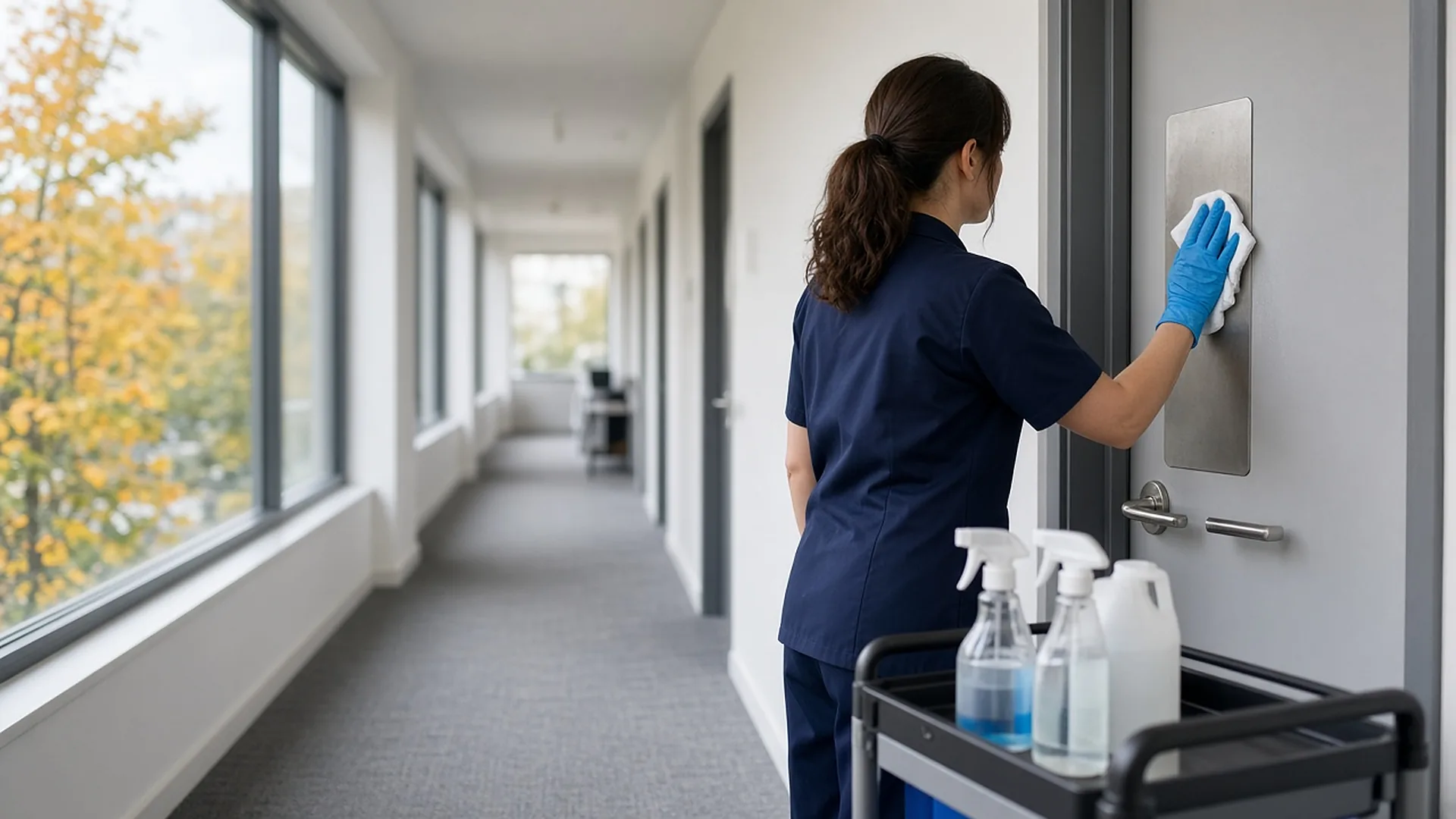
The standards include a list of high frequency touchpoints in Appendix 4 [1]. These are surfaces touched often by many people, which can transfer microorganisms between hands. In a surgery, think door handles and push plates, reception counters, chair arms, light switches, card machines, taps and dispensers, and couch controls. They need more frequent cleaning than the room as a whole.
How do the standards relate to CQC inspections?
CQC’s Regulation 15 (premises and equipment) aims to make sure the premises where care is delivered, and the equipment used, are clean, suitable, properly maintained and properly used. CQC adds that providers retain legal responsibility under the regulations even when they delegate responsibility through contracts to a third party [2]. In other words, outsourcing cleaning doesn’t outsource accountability. Whoever provides your contracted cleaning service, the practice needs evidence, such as schedules, audits and rectification records, that its contractor is meeting the standard.
Getting started with the 2025 standards in a GP or dental practice
✓List every functional area and room, and assign each an FR category with a written rationale.
✓Agree cleaning frequencies for each element, using Appendix 2 of the standards as the reference.
✓Set an audit calendar matching each FR category’s audit frequency.
✓Make sure your cleaning contract specifies compliance with the standards and the audit process.
✓Define responsibilities: what the cleaning team, clinical staff and estates or maintenance each clean.
✓Display star ratings and sign the Commitment to Cleanliness Charter.
✓Keep rectification records for at least three years.
✓Review results with partners or owners regularly, and act on anything at 3 stars or below.
What is the Commitment to Cleanliness Charter?
The 2025 standards promote a Commitment to Cleanliness Charter, set out in Appendix 5. NHS England describes it as continuing the collaborative ethos of 2021. By signing up, an organisation publicly commits to achieving a consistently safe and clean environment [1]. For a practice, displaying the charter alongside star ratings is a simple, visible signal of quality to patients.
How Prime Facility Services supports GP surgeries and dental practices
Our healthcare cleaners work in GP and doctors’ surgeries, dental practices, private clinics and hospices. Prime Facility Services brings more than 20 years of sector experience, from an owner-managed business based in Telford with an office in Dudley. We have held ISO 9001 and ISO 14001 accreditation since 2010 and Safecontractor accreditation since 2013.
Our healthcare cleaning protocols are tailored to each client, and technicians receive ongoing training to stay up to date with best practice. For practices working towards the 2025 standards, the relevant services are:
Tailored, flexible cleaning for clinical premises. Every job is overseen by a supervisor who inspects the work afterwards, and our equipment is regularly sanitised before use.
DBS-checked, trained and supervised teams, with digital time and attendance records for each visit.
What a practice cleaning plan can include
✓a walk-round with your infection prevention lead to agree which rooms sit in which functional risk category
✓cleaning frequencies and responsibilities set out room by room, in line with the standards
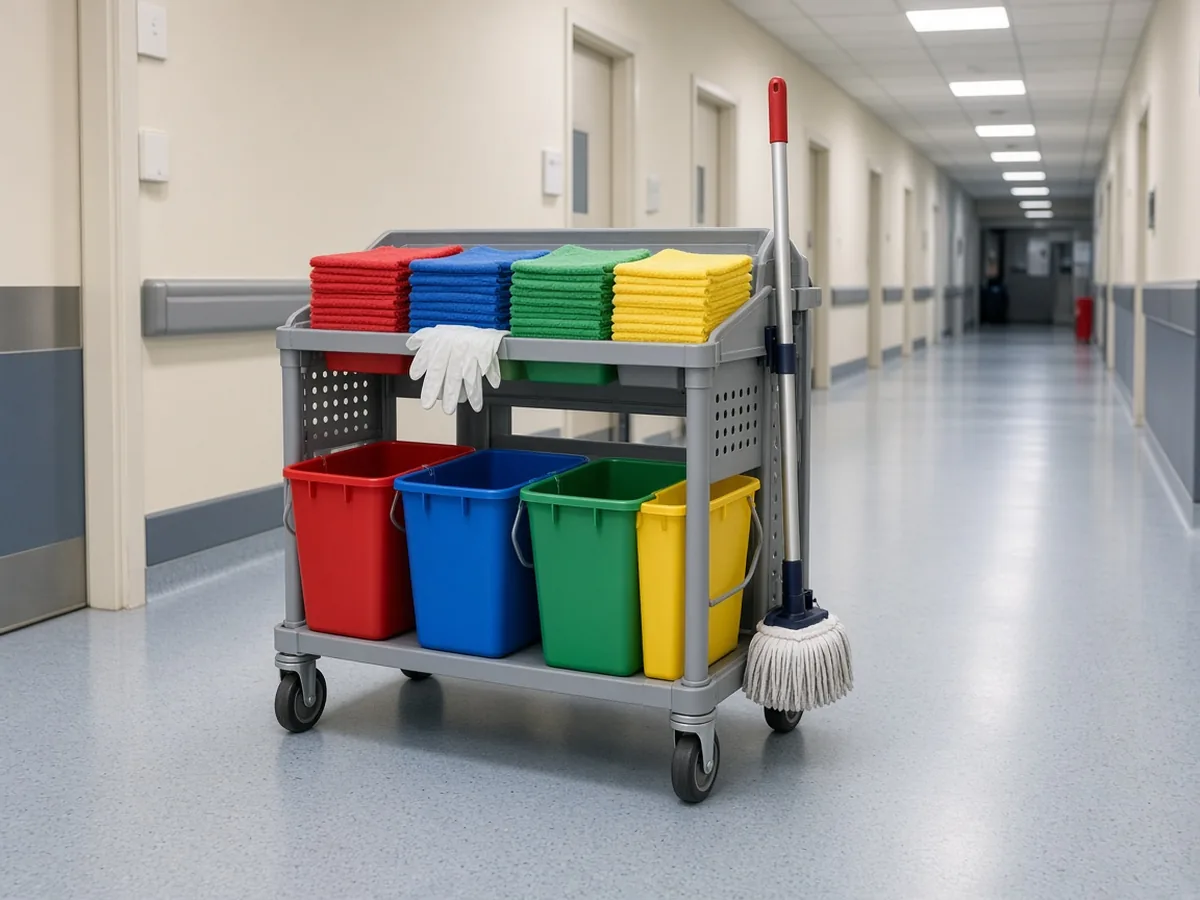
✓colour-coded equipment for clinical, washroom and general areas
✓records that support your own audits and star rating display
✓periodic deep cleans or decontamination of specific rooms when your risk assessment calls for it
Accountability for meeting the standards stays with the practice. A contractor’s role is to deliver the cleaning element to the agreed frequencies and help you evidence it.
The 2025 standards were published on 5 February 2025, replaced the 2021 version and apply to all healthcare organisations.
Rooms are allocated to functional risk categories FR1–FR6, with targets from 98% down to 75%.
Audit frequency runs from weekly (FR1) to annually (FR6).
Star ratings must be displayed; areas at 3 stars or below are automatically under review.
Compliance should be written into cleaning contracts, and CQC says providers stay legally responsible when they outsource.
Frequently asked questions
What are the National Standards of Healthcare Cleanliness 2025?
They are NHS England’s framework for cleaning, auditing and reporting on cleanliness in healthcare settings. They were published on 5 February 2025, apply to all healthcare organisations and replace the 2021 standards.
What are the functional risk categories?
Six categories, FR1 to FR6, that rate areas by risk. Audit target scores are 98% (FR1), 95% (FR2), 90% (FR3), 85% (FR4), 80% (FR5) and 75% (FR6).
How often should cleanliness audits be carried out?
According to the 2025 standards: weekly for FR1, monthly for FR2, every two months for FR3, every three months for FR4, every six months for FR5 and annually for FR6.
Do GP surgeries have to follow the National Standards of Healthcare Cleanliness?
NHS England says the 2025 standards apply to all healthcare organisations and that meeting aspects of them is mandatory. CQC Regulation 15 separately requires premises and equipment to be clean.
What happens if an area scores 3 stars or below?
It is automatically placed under review: the audit frequency is reviewed and an improvement plan is produced, actioned and signed off. A 1-star area is placed under investigation, with immediate action as appropriate.
How long must cleaning audit records be kept?
The 2025 standards say rectification records should be kept for a minimum of three years, or longer if local policy requires.
Can a contract cleaner help a GP practice meet the National Standards of Healthcare Cleanliness?
Yes. A contractor can deliver the cleaning element to the frequencies set for each functional risk category, while the practice stays accountable for the standards. Prime Facility Services provides healthcare cleaning for GP surgeries, dental practices and clinics, with every job inspected by a supervisor. Call 0800 566 8894 to arrange a walk-round.
Winter Norovirus and Flu: How to Prevent Outbreaks in the Workplace
Last winter, norovirus reports in England peaked at 627 a week in January, and flu took off in late October. Here’s how norovirus and flu spread at work, why hand gel isn’t enough, and the cleaning steps that make the biggest difference.
Daytime Cleaning and Energy Bills: Can Changing Your Cleaning Schedule Cut Building Costs?
Non-domestic electricity averaged 24.51p per kWh in Q2 2026, and lighting alone accounts for 15.5% of office electricity use. Moving cleaning into the working day can cut the hours a building runs. Here’s how to work out whether it adds up for you.
Void Turnaround Times: Why Every Day Empty Costs Housing Providers
The median social home in England now stands empty for 30 days between tenancies, up from an average of 21 days before the pandemic. Here’s what the latest government and regulator data says about void times, rent loss and demand, and where days can be won back.
National Standards of Healthcare Cleanliness 2025 Explained for GP Surgeries and Dental Practices
The National Standards of Healthcare Cleanliness 2025 replaced the 2021 version and apply to all healthcare organisations. Here’s what functional risk categories, audit target scores and star ratings mean for a GP surgery or dental practice.