Combustible Dust and Housekeeping in Warehouses: What DSEAR Requires
Posted on October 22, 2026
TL;DR – the short answer
Under DSEAR 2002, employers must assess and control the risk of fire and explosion from dangerous substances, including combustible dusts such as flour, sugar, wood and some plastics. The HSE says the most important mitigation measure is keeping buildings clean, because settled dust fuels the far more destructive “secondary” explosion. That means regular cleaning with suitable vacuum systems rather than brushes or compressed air, and not forgetting high-level surfaces.
Dust is easy to overlook. It settles on beams, racking tops, light fittings and ducting where nobody looks, and it builds up slowly. In warehouses, food production units and distribution centres, that build-up can be more than a cleanliness problem. If the dust is combustible, it can turn a small incident into a building-wide explosion.
This guide explains what the law expects, why housekeeping sits at the centre of dust explosion safety, and how to clean dusty sites without making the risk worse.
0.3mm
Layer of flour that can in principle fill a room with an explosible cloud up to 3m high
Source: HSE, HSG103
5mm
Maximum dust deposit that electrical equipment standards assume
Source: HSE, HSG103
40,000
Average annual non-fatal injuries in UK transportation and storage, 2022/23–2024/25
Source: HSE, 2025
What is DSEAR?
The Dangerous Substances and Explosive Atmospheres Regulations 2002 (DSEAR) require employers to control the risks from fire, explosion and similar events caused by dangerous substances at work. HSE’s guide INDG370 sets out what that means in practice: identify the hazards, assess the risks, put controls in place, and plan for accidents and emergencies [2].
“Dangerous substances” covers more than flammable liquids and gases. Many everyday materials become explosive when finely divided and dispersed as a cloud. For the food industry, HSE lists flour, custard powder, instant coffee, sugar, dried milk, potato powder and soup powder as examples of explosible dusts [3].
Plain-English definition: a combustible dust is any fine solid particle that can burn. When enough of it is suspended in air and meets an ignition source, it can ignite so fast that it causes an explosion.
Why is housekeeping so important for dust explosions?
HSE’s guidance on combustible dusts, HSG103, is blunt: “The most important mitigation measure is maintaining the process buildings in a clean condition.”[1]
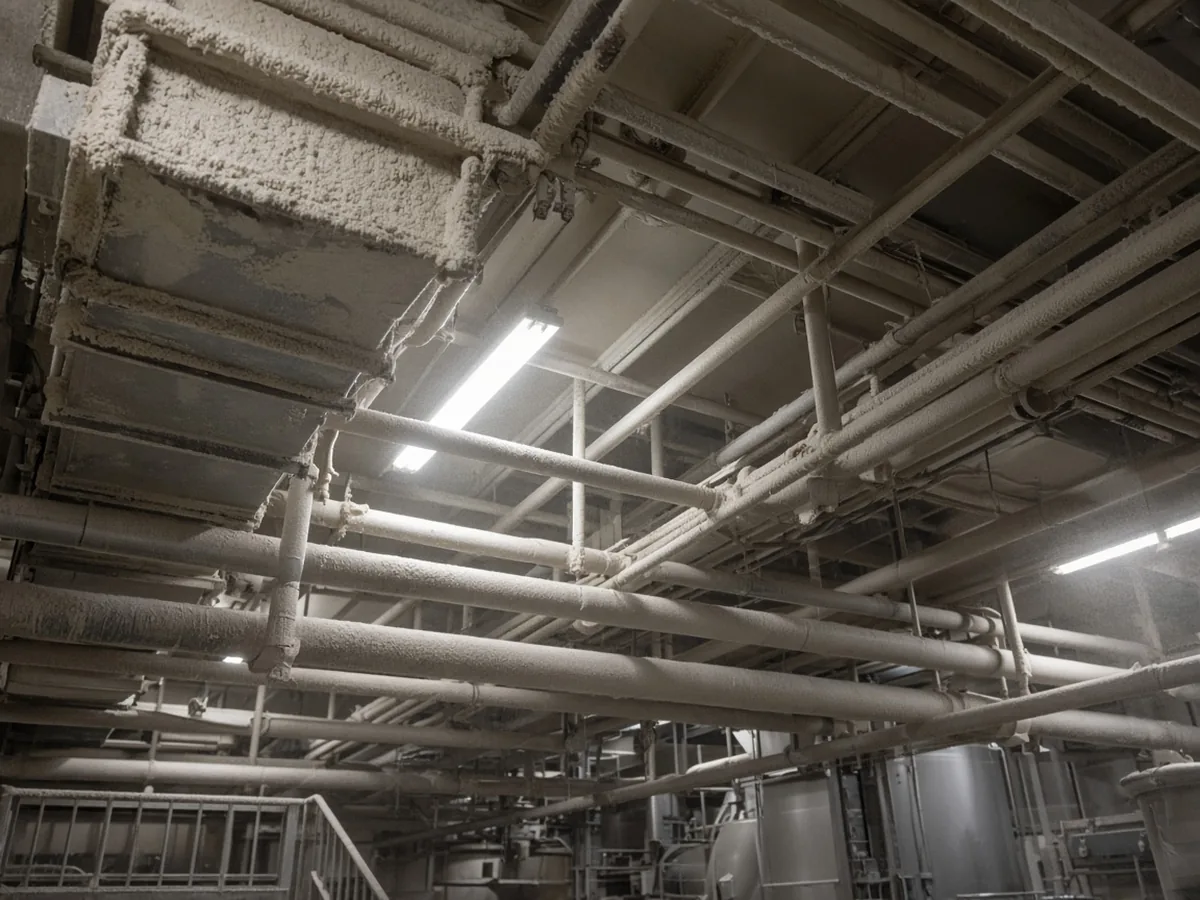
The reason is the secondary explosion. A small primary event, perhaps inside a machine, a dust extraction unit or a silo, sends a pressure wave through the building. That wave shakes settled dust off every ledge, beam and pipe into the air, and the resulting cloud then ignites. HSE notes that the secondary explosion is generally more destructive than the first [1].
The amount of dust needed is surprisingly small. HSE says that a layer of flour just 0.3mm thick on the floor can, in principle, fill a room with an explosible dust cloud up to 3m above floor level[1]. That’s thinner than a credit card.
What does DSEAR require employers to do?
HSE breaks the DSEAR risk assessment into five steps [2]:
Steps summarised from HSE INDG370, Controlling fire and explosion risks in the workplace.
Step
What HSE expects
Where cleaning fits
1. Identify hazards
Identify dangerous substances, ignition sources and work activities that involve them
Map where dust is produced and where it settles, including high-level areas
2. Assess the risks
Consider how likely a fire or explosion is and how severe it could be
Dust build-up raises both likelihood and severity
3. Control the risks
Remove or substitute the substance where possible; otherwise control and mitigate
Housekeeping is a key mitigation measure
4. Record and implement
If you employ five or more people, record the significant findings
Document cleaning frequencies, methods and responsibilities
5. Review
Keep the assessment up to date, especially after changes
Re-check frequencies when throughput, products or layout change
Where an explosive atmosphere could occur, DSEAR also requires areas to be classified into zones. For dusts, these are Zone 20, Zone 21 and Zone 22, in order of how often an explosive dust cloud is likely to be present [2]. Equipment used in those zones, including cleaning equipment, must be suitable for the zone.
How should combustible dust be cleaned safely?
The wrong cleaning method can create exactly the dust cloud you are trying to prevent. HSE’s guidance is consistent on the following points [1][3]:
Safe dust housekeeping: the HSE essentials
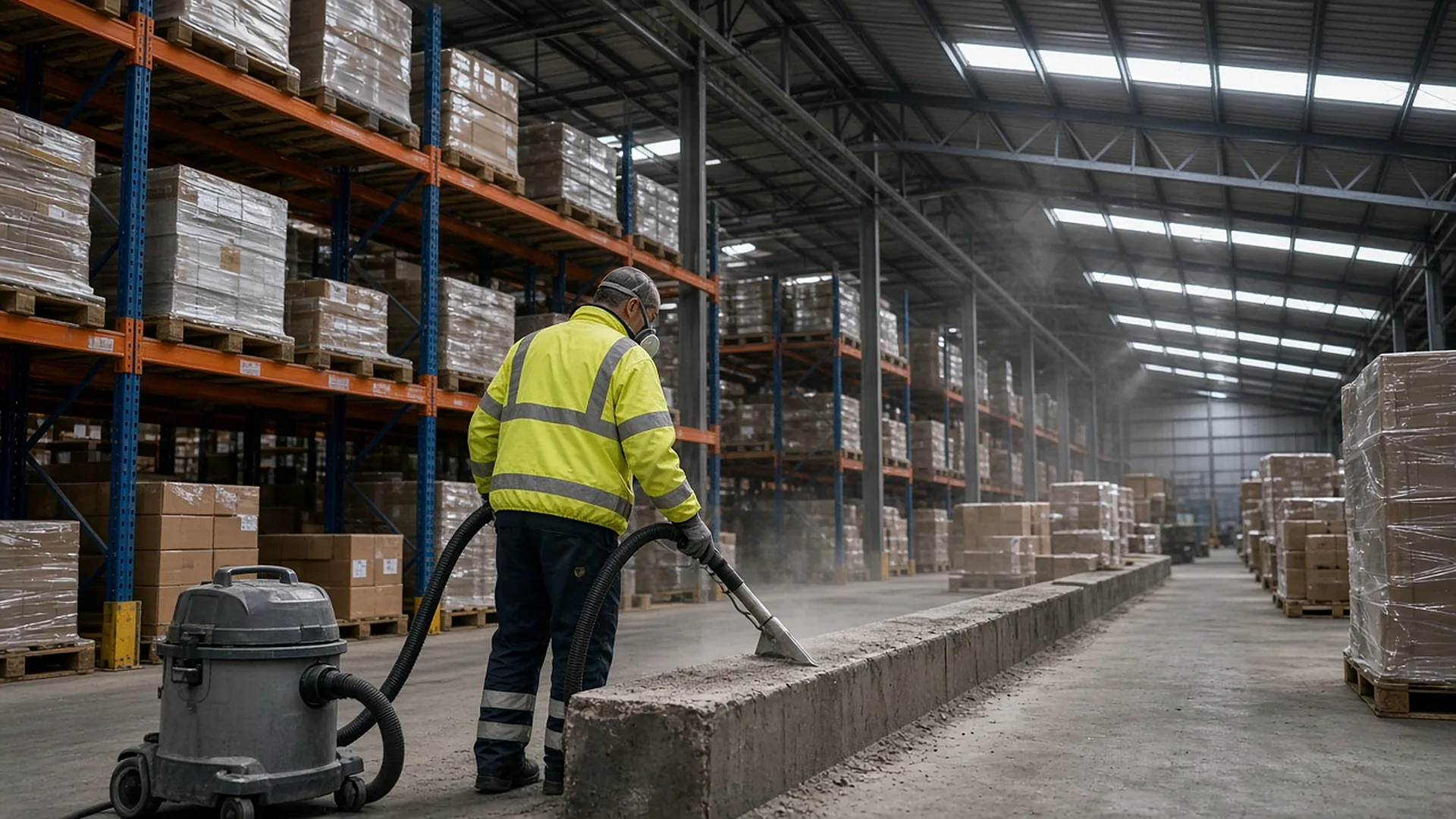
✓Vacuum, don’t sweep: HSE prefers vacuum systems to brushes and shovels, which tend to raise dust clouds.
✓No compressed air: avoid compressed air lines to dislodge deposits, because they create dust clouds.
✓Right vacuum for the zone: don’t use domestic vacuum cleaners. Use industrial machines suited to the dust and, in classified areas, to the zone.
✓Control ignition from tools: HSE advises avoiding aluminium tools, earthing metallic tools, and taking care with spiral-wound reinforcing wires in hoses.
✓Look up: don’t neglect the highest parts of buildings. HSE says that is where the finest and most hazardous dust is often found.
✓Watch electrical equipment: electrical standards assume dust deposits never exceed 5mm. If you can’t keep below that, get specialist advice.
✓Fix leaks first: keep plant leak-tight, because loose flanges, damaged seals and propped-open hatches are common sources of dust.
Which areas of a warehouse get missed?
On most of the sites we visit, floor-level cleaning is fine. The problems are higher up. The usual blind spots are:
Racking tops and the upper beam levels of pallet racking
Roof steelwork, purlins and lighting rafts
Ductwork, cable trays and the tops of air-handling units
The tops of mezzanines, machine guards and conveyor housings
Areas around baling machines, dust extraction units and loading dock levellers
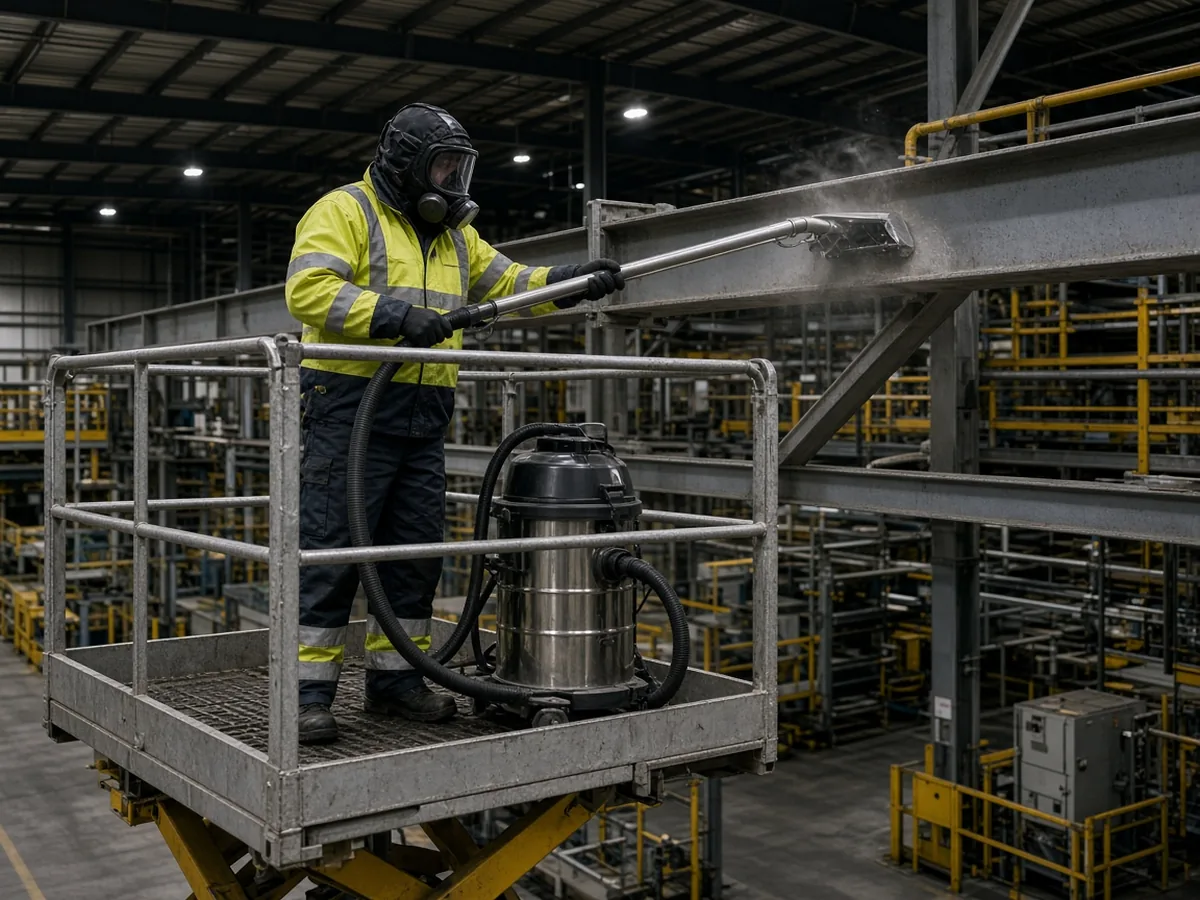
Reaching these areas safely needs planning, the right access equipment and trained operatives. A scheduled programme of cleaning at height with powered access means dust doesn’t accumulate unseen between annual shutdowns.
How does this fit with wider warehouse safety?
Dust control isn’t only about explosions. Housekeeping also affects slips and trips, fire load and air quality. HSE figures for the transportation and storage sector show an average of 40,000 workers sustaining non-fatal injuries each year between 2022/23 and 2024/25, and 67,000 workers suffering from work-related ill health [4]. A clean, uncluttered warehouse floor, with pallets, shrink-wrap and dust cleared away, supports every part of that picture.
How Prime Facility Services helps keep warehouses and production sites dust-safe
We have cleaned factories, warehouses and manufacturing plants across the Midlands for more than 20 years, from our Telford head office and our Dudley base. Prime Facility Services is owner-managed. Our quality management system holds ISO 9001 and ISO 14001 accreditation (since 2010), and we have been Safecontractor-accredited since 2013. Our staff are checked and audited under ISO, IPAF, Safecontractor and IOSH.
For combustible dust, the work usually falls into these services:
Cleaning of elevated areas, ventilation shafts, gutters and pipework. Our project managers complete a risk assessment before any high-level work starts, and operatives using scissor lifts need IPAF and PASMA training.
DSEAR 2002 applies to combustible dusts as well as flammable liquids and gases.
HSE calls keeping buildings clean “the most important mitigation measure” against dust explosions.
A 0.3mm layer of flour can in principle create an explosible cloud up to 3m high (HSE HSG103).
Use suitable vacuum systems, not brushes or compressed air, and never domestic vacuums.
High-level surfaces are where the finest, most hazardous dust collects, so schedule them as well.
Frequently asked questions
Does DSEAR apply to dust?
Yes. DSEAR covers dangerous substances that can cause fire or explosion, including combustible dusts such as flour, sugar, dried milk and many other fine powders.
What is a secondary dust explosion?
It happens when a smaller first explosion shakes settled dust off ledges and surfaces into the air, and that cloud then ignites. HSE says secondary explosions are generally more destructive than the first.
Can you use compressed air to clean dust?
HSE advises against using compressed air lines to dislodge dust deposits, because this creates dust clouds. Vacuum systems are preferred.
Can I use a normal vacuum cleaner on combustible dust?
No. HSE says not to use domestic vacuum cleaners. Use industrial equipment suitable for the dust and, in classified areas, equipment suitable for the zone.
What are dust zones under DSEAR?
Areas where explosive dust atmospheres may occur are classified as Zone 20, 21 or 22, in order of how often an explosive dust cloud is likely to be present. Equipment must be suitable for the zone.
How often should high-level dust be cleaned?
There is no fixed legal frequency. It should be set by your DSEAR risk assessment and based on how quickly dust accumulates. HSE notes that electrical standards assume deposits never exceed 5mm.
Can a cleaning contractor help with DSEAR housekeeping?
Yes. A contractor can carry out the high-level and floor cleaning your DSEAR risk assessment requires, at the frequency it sets, while the assessment itself stays with you as the duty holder. Prime Facility Services provides high-level, warehouse and manufacturing cleaning, with a risk assessment before any work at height. Call 0800 566 8894 to arrange a survey.
Winter Norovirus and Flu: How to Prevent Outbreaks in the Workplace
Last winter, norovirus reports in England peaked at 627 a week in January, and flu took off in late October. Here’s how norovirus and flu spread at work, why hand gel isn’t enough, and the cleaning steps that make the biggest difference.
Daytime Cleaning and Energy Bills: Can Changing Your Cleaning Schedule Cut Building Costs?
Non-domestic electricity averaged 24.51p per kWh in Q2 2026, and lighting alone accounts for 15.5% of office electricity use. Moving cleaning into the working day can cut the hours a building runs. Here’s how to work out whether it adds up for you.
Void Turnaround Times: Why Every Day Empty Costs Housing Providers
The median social home in England now stands empty for 30 days between tenancies, up from an average of 21 days before the pandemic. Here’s what the latest government and regulator data says about void times, rent loss and demand, and where days can be won back.
National Standards of Healthcare Cleanliness 2025 Explained for GP Surgeries and Dental Practices
The National Standards of Healthcare Cleanliness 2025 replaced the 2021 version and apply to all healthcare organisations. Here’s what functional risk categories, audit target scores and star ratings mean for a GP surgery or dental practice.