The Real Cost of Graffiti and Vandalism to UK Businesses, and Why Speed of Removal Matters
Posted on October 22, 2026
TL;DR – the short answer
Graffiti and vandalism cost businesses far more than the price of a clean-up. There is the repair, staff time, lost trade from a tired-looking frontage, insurance excesses and the risk of repeat attacks. The latest ONS figures show police in England and Wales recorded 433,251 criminal damage offences in the year ending March 2026. The Home Office’s Commercial Victimisation Survey found 8% of business premises experienced vandalism in a year. The most cost-effective response is usually to remove graffiti quickly, using the right method for the surface.
A tag on a shutter or a scrawl across a fresh render can appear overnight. It’s tempting to treat it as a cosmetic nuisance and get to it eventually. But for business owners, landlords and facilities managers across Telford, Shropshire and the wider West Midlands, the longer it stays, the more it costs.
This article sets out what the latest UK crime figures say, the hidden costs that rarely show up on an invoice, and why speed of removal matters so much.
433,251
Criminal damage offences recorded by police in England and Wales, year ending March 2026
Source: ONS, 2026
8%
of business premises experienced vandalism in the previous 12 months
Source: Home Office CVS 2023
41%
of wholesale and retail premises experienced at least one crime in a year
Source: Home Office CVS 2023
How common is vandalism and criminal damage in the UK?
Graffiti is usually recorded as criminal damage, alongside other deliberate damage to property such as smashed windows and damaged vehicles. The Office for National Statistics (ONS) published its latest figures for England and Wales on 23 July 2026 [1]:
Police recorded 433,251 criminal damage offences in the year ending March 2026, a 2% fall on the previous year. Police recorded crime includes offences against businesses.
The Crime Survey for England and Wales estimated around 646,000 incidents of criminal damage against households and individuals. That is no statistically significant change on the year before, but 47% lower than ten years earlier and 81% below the mid-1990s peak.
So the long-term trend is downward, but the numbers are still large and the decline has flattened. For any individual business, the question isn’t whether vandalism is falling nationally. It’s what happens when it lands on your wall.
How many businesses are affected by vandalism?
The household crime survey doesn’t cover businesses, so the best national source is the Home Office’s Commercial Victimisation Survey (CVS). The 2023 survey, covering all commercial sectors, found [2]:
Source: Home Office, Crime against businesses: findings from the 2023 Commercial Victimisation Survey.
Measure (business premises, England and Wales)
2023 CVS finding
Premises experiencing any CVS crime in the previous 12 months
Wholesale and retail premises experiencing any CVS crime
41%
Premises experiencing what they perceived as anti-social behaviour
8%
Victims of crime who reported at least one crime to the police
55%
Vandalism affected roughly one in twelve premises, as many as burglary. Retail and wholesale premises, which are open to the public and often on high streets, are hit hardest across all crime types [2]. The CVS also found that among premises affected by anti-social behaviour, the most commonly reported impacts were general nuisance (33%) and it being upsetting or disruptive for staff (29%) [2].
What does graffiti and vandalism really cost a business?
There is no single, current national figure for the cost of graffiti to UK businesses. Older estimates exist, but they are too dated to rely on. What we can do is break down the costs a business actually carries. Some appear on an invoice. Many don’t.
Cost
What it looks like in practice
Visible on an invoice?
Removal and repair
Specialist cleaning, repainting, replacement glazing or shutters
Yes
Staff and management time
Reporting, photographing, contacting police, insurers and contractors
No
Insurance
Excesses, claims history and potentially higher premiums
Partly
Lost trade and reputation
A neglected-looking frontage deters customers and prospective tenants
No
Repeat attacks
Untreated graffiti tends to attract more, multiplying the bill
No
Surface damage
Wrong chemicals or high pressure can permanently mark brick, stone or render
Later
Staff wellbeing
Feeling unsafe or demoralised at work
No
The hidden-cost rule of thumb: the clean-up invoice is often the smallest part of the bill. The rest comes from time, trade and repeat damage, and all three grow the longer graffiti stays up.
Why does speed of removal matter?
Fast removal matters for three practical reasons.
1. Paint gets harder to remove over time
Spray paint and marker ink cure and soak into porous surfaces such as brick, sandstone, concrete and render. The longer they stay, the deeper they go and the more aggressive the removal has to be, which raises both cost and the risk of “ghosting” (a faint shadow left behind).
2. Graffiti invites more graffiti
A tag left in place signals that nobody is watching and nobody cares. Those who manage estates, retail parks and transport sites commonly report that quickly cleaned surfaces are re-targeted less often than neglected ones.
3. First impressions are commercial
Customers, tenants and visitors judge a business by its frontage. Graffiti, especially offensive content, can do disproportionate damage to how a site is perceived, and offensive or hateful graffiti should always be treated as urgent.
How should graffiti be removed without damaging the surface?
The right method depends on the surface, the paint and how long it has been there. Getting it wrong can cost more than the graffiti itself.
Choosing the right removal approach
✓Identify the surface first: brick, natural stone, render, painted metal, glass and powder-coated shutters all need different treatment.
✓Test a small area: try the method somewhere inconspicuous before treating the whole tag.
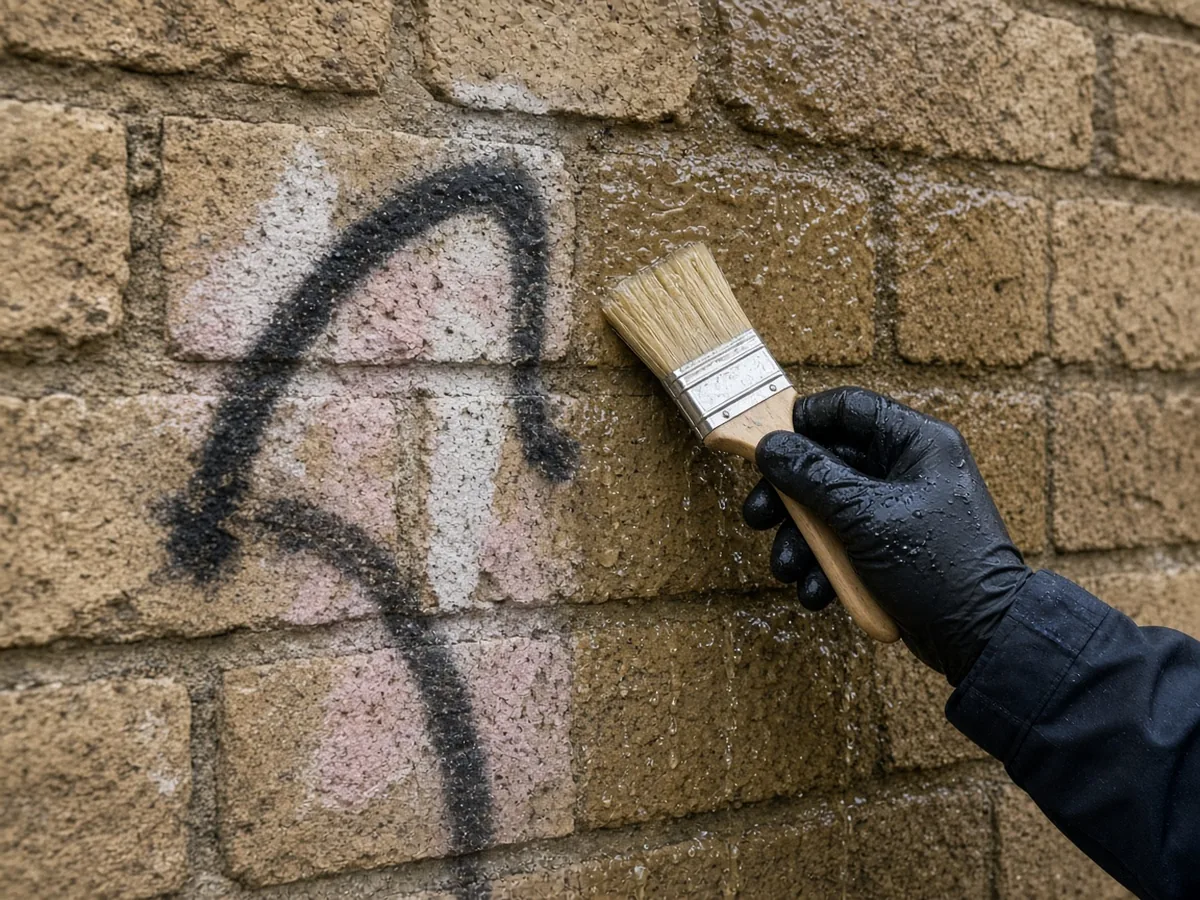
✓Use the gentlest effective method: specialist gels and poultices, then low-pressure hot water, before any harsher technique.
✓Mind the run-off: contain and collect chemical waste rather than washing it into surface drains.
✓Consider anti-graffiti coatings: sacrificial or permanent coatings on repeat-target surfaces make future removal faster and cheaper.
✓Record everything: take photos before and after for police reports and insurance claims.
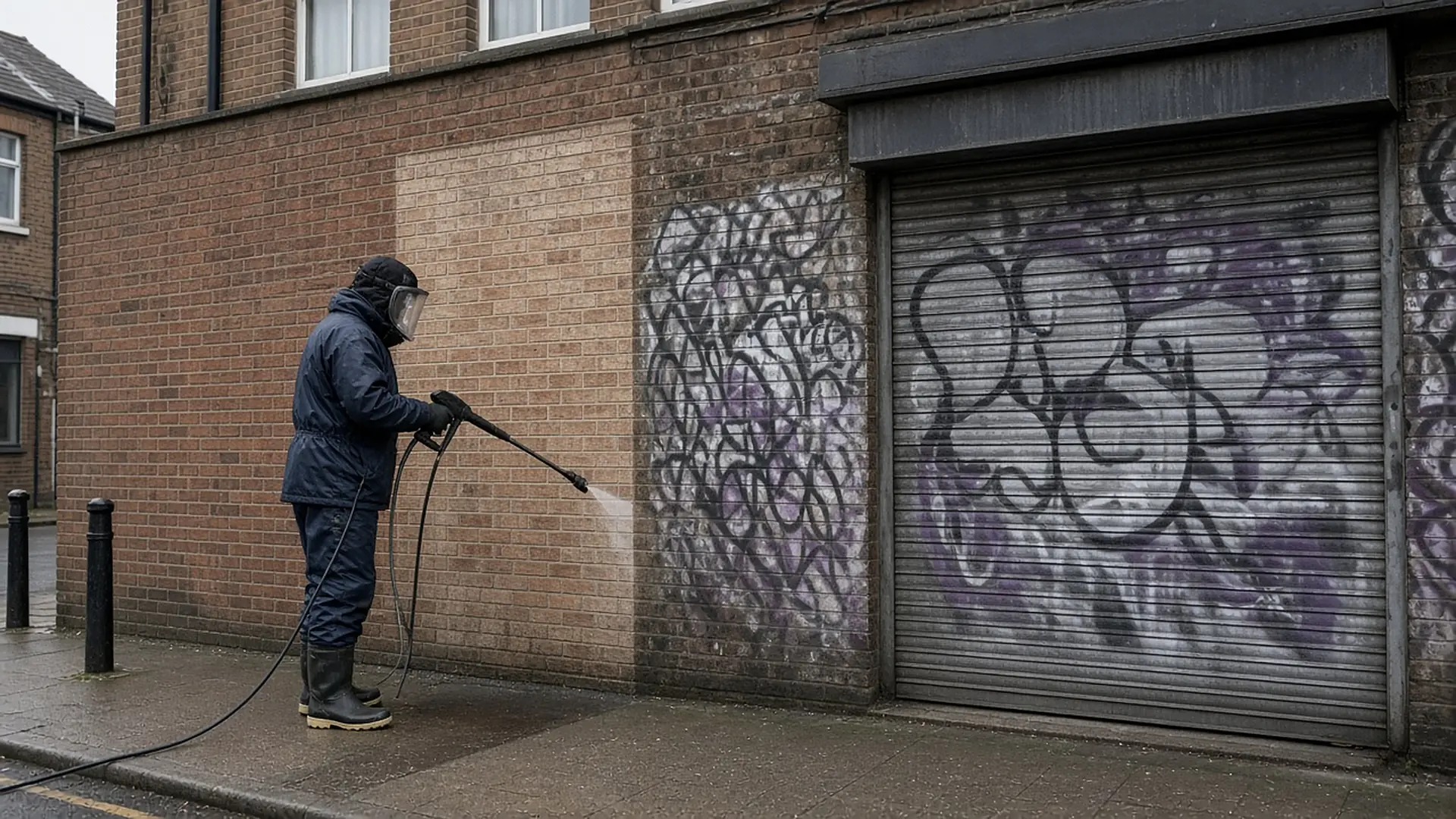
For heritage brick and soft stone, a heavy-handed pressure washer can open up the surface and make future staining worse. Specialist graffiti cleaning on sensitive surfaces uses controlled chemistry and temperature to lift paint without etching the substrate. On robust surfaces such as concrete and paving, controlled hot-water jet washing may be the quicker option.
What can businesses do to reduce vandalism?
The CVS lists the types of crime prevention measures businesses use, including protective measures outside the premises such as security lighting, CCTV, gates and fences, and “soft” measures such as staff vigilance training [2]. Alongside those, practical steps include:
A rapid-response agreement with a cleaning contractor, so removal happens within a set time rather than “when someone gets round to it”.
Good lighting and sightlines around walls, shutters and bin stores.
Anti-graffiti coatings on surfaces that are repeatedly targeted.
Reporting every incident to the police. The CVS found only 55% of premises that experienced crime reported at least one incident [2], and unreported crime can’t inform local policing.
Regular exterior cleaning to keep the whole site looking cared for.
How Prime Facility Services helps businesses remove graffiti and protect their frontage
Prime Facility Services has more than 20 years of experience in cleaning and removing vandalism, and no job is too small or too large. We are owner-managed and operate from Telford and Dudley, so our teams are local to sites across Shropshire, Staffordshire and the West Midlands. We are accredited to ISO 9001 and ISO 14001 (since 2010) and to Safecontractor (since 2013).
Unwanted or offensive graffiti can damage your reputation and how customers see you. These are the services businesses use most for graffiti and a tidy exterior:
Police in England and Wales recorded 433,251 criminal damage offences in the year ending March 2026 (ONS).
8% of business premises experienced vandalism in a year, and 41% of wholesale and retail premises experienced crime (Home Office CVS 2023).
Most of the cost of graffiti is hidden: time, trade, insurance and repeat attacks.
Remove graffiti fast, before paint cures into porous surfaces and invites more tags.
Use the gentlest effective method for each surface, and consider protective coatings for repeat targets.
Frequently asked questions
Is graffiti a criminal offence in the UK?
Yes. Graffiti is generally treated as criminal damage, and police record it alongside other deliberate damage to property.
How many criminal damage offences are there in England and Wales?
Police recorded 433,251 criminal damage offences in the year ending March 2026, a 2% fall on the previous year, according to the ONS.
How many businesses experience vandalism?
The Home Office’s 2023 Commercial Victimisation Survey found that 8% of business premises in England and Wales experienced vandalism in the previous 12 months.
Why should graffiti be removed quickly?
Paint cures and soaks into porous surfaces over time, making removal harder and costlier, and graffiti left in place tends to attract more.
Can pressure washing damage brick?
Yes. High pressure or the wrong chemicals can erode soft brick, stone and mortar and leave permanent marks. Use the gentlest effective method and test a small area first.
What is an anti-graffiti coating?
It is a protective treatment applied to a surface so that future graffiti can be removed more easily. Sacrificial coatings are removed with the graffiti; permanent coatings stay in place.
Can graffiti be removed without damaging brickwork?
Usually, if the method suits the surface. Soft brick and stone need gentler chemistry and controlled pressure, while concrete and metal can take hot-water jet washing. Prime Facility Services provides specialist graffiti removal alongside jet wash and cladding cleaning. Call 0800 566 8894 with photos of the affected area.
Winter Norovirus and Flu: How to Prevent Outbreaks in the Workplace
Last winter, norovirus reports in England peaked at 627 a week in January, and flu took off in late October. Here’s how norovirus and flu spread at work, why hand gel isn’t enough, and the cleaning steps that make the biggest difference.
Daytime Cleaning and Energy Bills: Can Changing Your Cleaning Schedule Cut Building Costs?
Non-domestic electricity averaged 24.51p per kWh in Q2 2026, and lighting alone accounts for 15.5% of office electricity use. Moving cleaning into the working day can cut the hours a building runs. Here’s how to work out whether it adds up for you.
Void Turnaround Times: Why Every Day Empty Costs Housing Providers
The median social home in England now stands empty for 30 days between tenancies, up from an average of 21 days before the pandemic. Here’s what the latest government and regulator data says about void times, rent loss and demand, and where days can be won back.
National Standards of Healthcare Cleanliness 2025 Explained for GP Surgeries and Dental Practices
The National Standards of Healthcare Cleanliness 2025 replaced the 2021 version and apply to all healthcare organisations. Here’s what functional risk categories, audit target scores and star ratings mean for a GP surgery or dental practice.