Heat-Health Alerts and Hygiene: Keeping Workplaces Safe in a UK Heatwave
Posted on October 22, 2026
TL;DR – the short answer
Hot weather makes workplace hygiene harder, not just less comfortable. Bacteria multiply faster in the 8°C–63°C “danger zone”, warm stagnant water favours legionella, and busier washrooms and water points spread germs. The UK Health Security Agency (UKHSA) runs its heat-health alert season from 1 June to 30 September. Treat a yellow or amber alert as the trigger to move food checks, touchpoint cleaning and washroom checks onto a more frequent “hot weather schedule”.
Last summer reset expectations. According to the Met Office, summer 2025 was the warmest on record for the UK, and the temperature peaked at 35.8°C in Faversham, Kent [2]. For facilities managers in Shropshire, the Black Country and across the West Midlands, a heatwave is no longer a rare event to improvise around. It is a predictable seasonal risk, and it deserves a written plan.
This guide explains how the UK heat-health alerts work, what the law actually says about temperature at work, and the practical hygiene changes that keep offices, canteens and shared spaces safe when the thermometer climbs.
16.10°C
UK mean temperature for summer 2025, the warmest summer on record
Source: Met Office, 2025
1,504
Heat-associated deaths in England across five heat episodes in summer 2025
Source: UKHSA, 2026
8°C
Legal maximum for chilled food in England, Wales and Northern Ireland
Source: Food Standards Agency
What is a heat-health alert?
A heat-health alert (HHA) is a warning issued by UKHSA, working with the Met Office, when forecast temperatures are likely to harm people’s health. Since June 2023 the alerts have been impact-based: each one combines how likely high temperatures are with how severe the effects could be, rather than only reporting a temperature threshold [1].
Alerts are colour-coded yellow, amber or red. The core alerting season runs from 1 June to 30 September, although alerts can be issued outside it if needed [1].
Alert meanings summarised from UKHSA’s Heat-Health Alerting system guidance. Workplace responses are Prime Facility Services recommendations, not statutory requirements.
Alert level
What UKHSA says it means
Suggested workplace hygiene response
Yellow
Heat is likely to affect people who are particularly vulnerable, such as older people or those with health conditions.
Check fridge logs twice a day, top up drinking water points, and brief cleaning teams on the hot weather schedule.
Amber
Impacts are likely across the whole health service, with potential to affect the whole population.
Clean touchpoints and washrooms more often, carry out extra bin collections, and flush little-used outlets.
Red
Significant risk to life, even for healthy people.
Move heavy cleaning tasks to the coolest hours, review lone working, and keep only essential deep-clean tasks.
The health stakes are real. UKHSA’s heat mortality monitoring report for summer 2025, published in April 2026, estimated 1,504 heat-associated deaths in England across five heat episodes. The burden was highest among people aged 85 and over, and the West Midlands was among the regions with significant excess mortality [3]. Most of those deaths were not at work, but they show why employers with older staff, visitors or customers need to take alerts seriously.
Is there a maximum working temperature in the UK?
No. The Health and Safety Executive (HSE) states that there is no law for a maximum working temperature, because conditions vary too much between workplaces. There is a guideline minimum: an indoor workplace should normally be at least 16°C, or 13°C where work involves rigorous physical effort [4].
That does not mean heat can be ignored. Employers must still keep indoor temperatures “reasonable” and assess heat as a risk to health, including heat stress and dehydration [4]. For cleaning teams this matters twice over. Cleaning is physical work, often done in kitchens, plant rooms and washrooms that run hotter than the rest of the building, and the operatives doing it are part of your workforce or your supply chain.
Plain-English definition:Heat stress happens when the body can no longer control its internal temperature. HSE lists factors such as air temperature, humidity, work rate and clothing, and warns that heavy sweating can lead to dehydration [4].
Why does hot weather make workplace hygiene harder?
Heat changes the hygiene picture in four main ways.
1. Food spoils faster
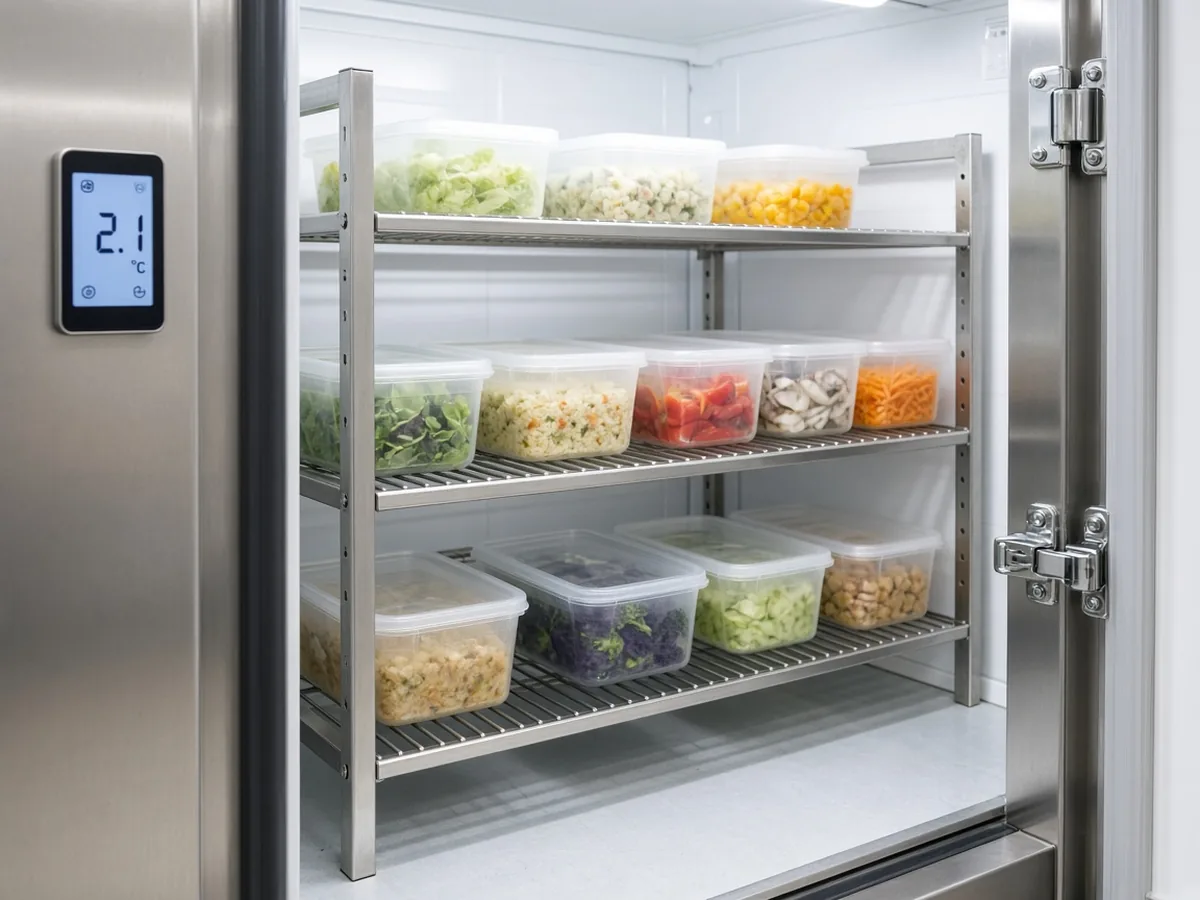
The Food Standards Agency (FSA) explains that chilled food must legally be kept at 8°C or below in England, Wales and Northern Ireland, and recommends setting fridges to 5°C or below. Bacteria grow fastest between 8°C and 63°C, and chilled food should be out of the fridge for no more than four hours [5]. In a heatwave, office fridges are opened more often, staff lunches sit on desks, and buffet food from meetings warms up quickly.
2. Warm water systems can grow legionella
HSE notes that legionella risk rises when water in all or part of a system is between 20°C and 45°C, which suits bacterial growth, and when spray or aerosol can be created [6]. Hot weather warms cold-water pipework, especially in buildings that are half-empty over the summer holidays. Showers, little-used basins and spray taps all need attention.
3. Touchpoints get busier
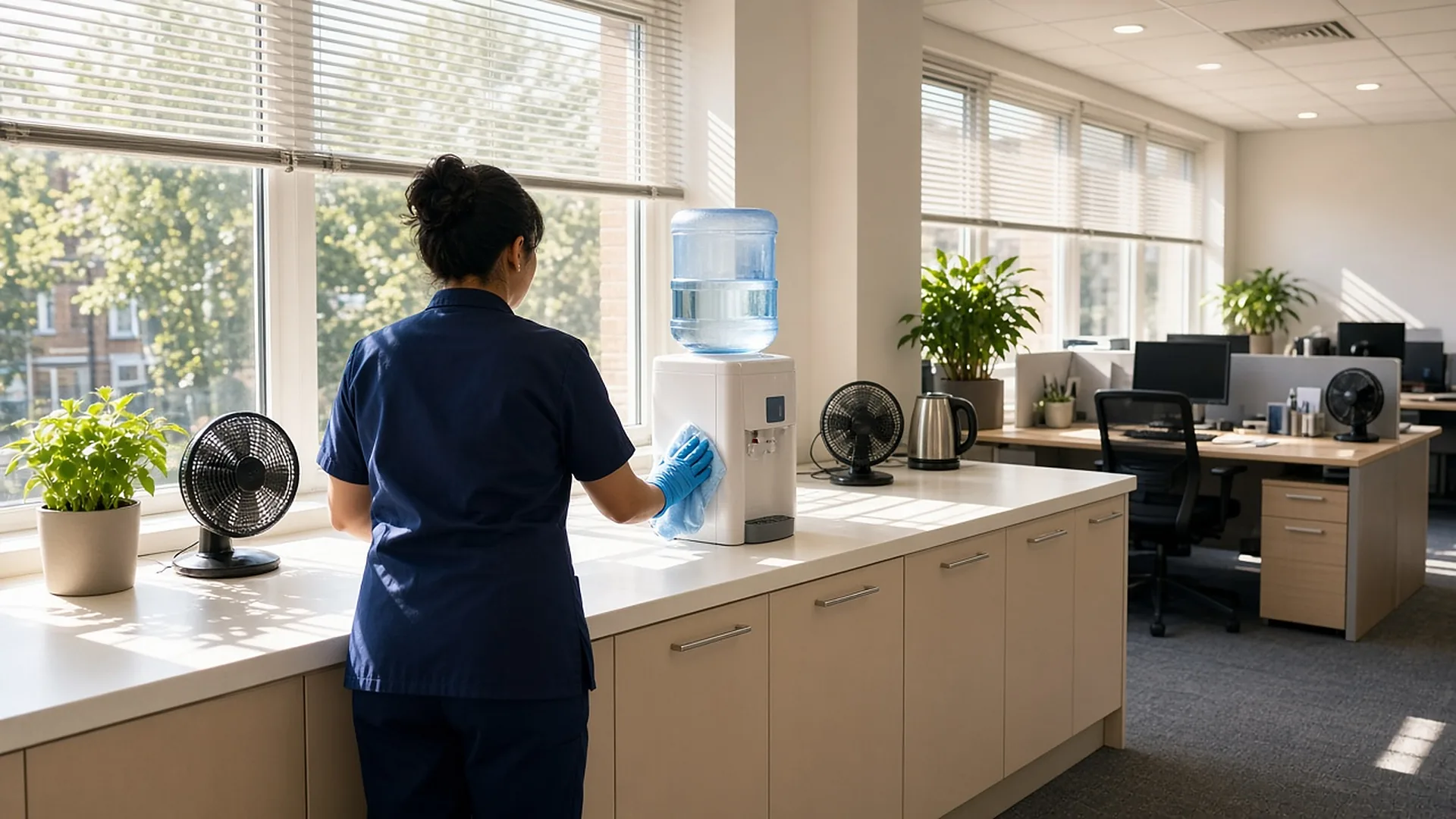
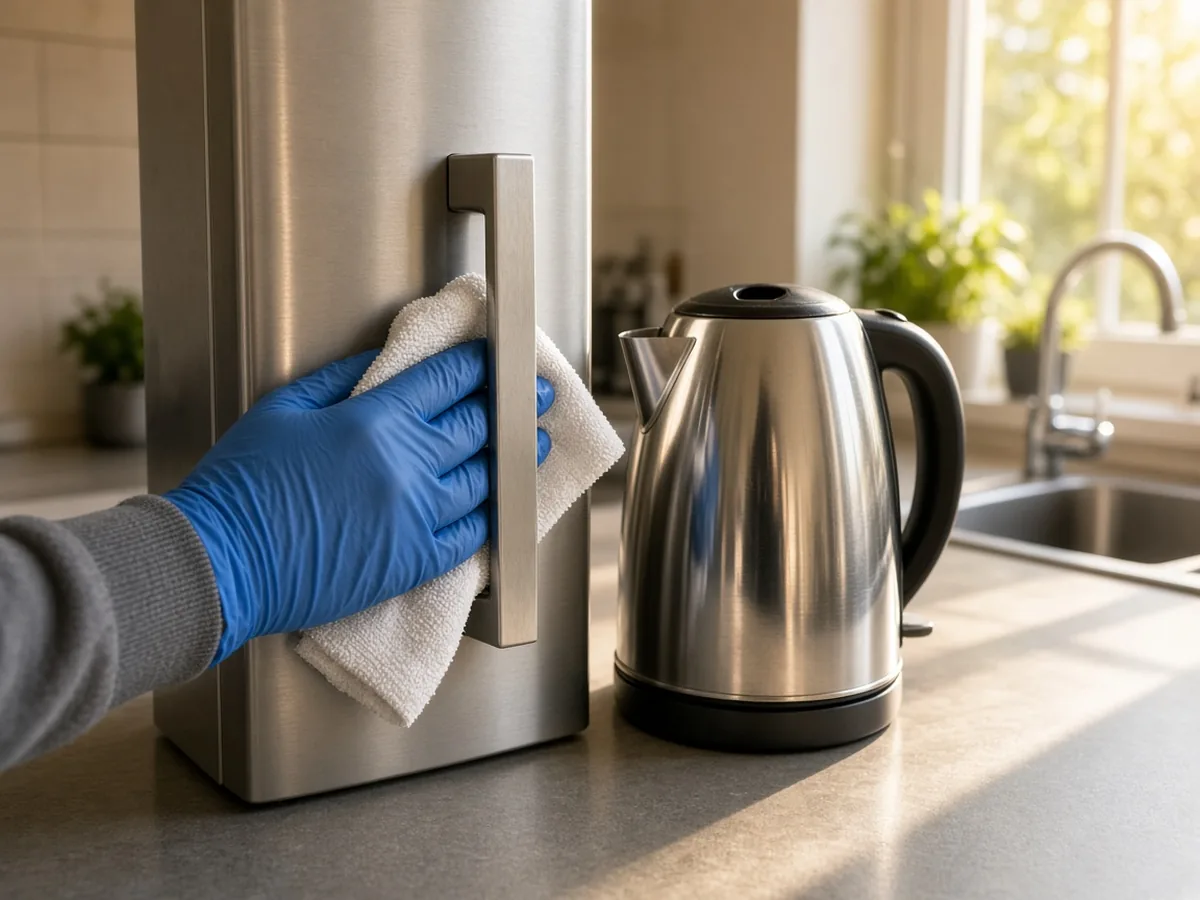
Water coolers, kettles, fridge handles and fan controls are suddenly used by everyone, many times a day. Warm, humid air and sweaty hands make these surfaces dirtier, faster.
4. Waste and odours build up
Food waste left in warm bins attracts flies and produces odours within hours. Washrooms see more traffic as people drink more, so consumables run out sooner and floors get wetter.
How should cleaning schedules change during a heatwave?
The simplest approach is to agree a “hot weather schedule” in advance, then switch it on whenever UKHSA issues an amber alert for your region. This is the checklist we suggest building into your site specification.
Hot weather hygiene checklist
✓Kitchens and tea points: record fridge temperatures at least twice a day; clear out uncovered or unlabelled food daily; sanitise fridge handles, kettles and water-cooler taps several times a day.
✓Washrooms: add an extra midday check for soap, paper towels and hand sanitiser; mop wet floors promptly to prevent slips; clean urinals and drains more often to control odours.
✓Water hygiene: flush little-used outlets and showers in line with your legionella risk assessment; report any warm water from cold taps to your responsible person.
✓Waste: empty food waste bins at least daily and line them; keep external bin stores shut and away from windows and air intakes.
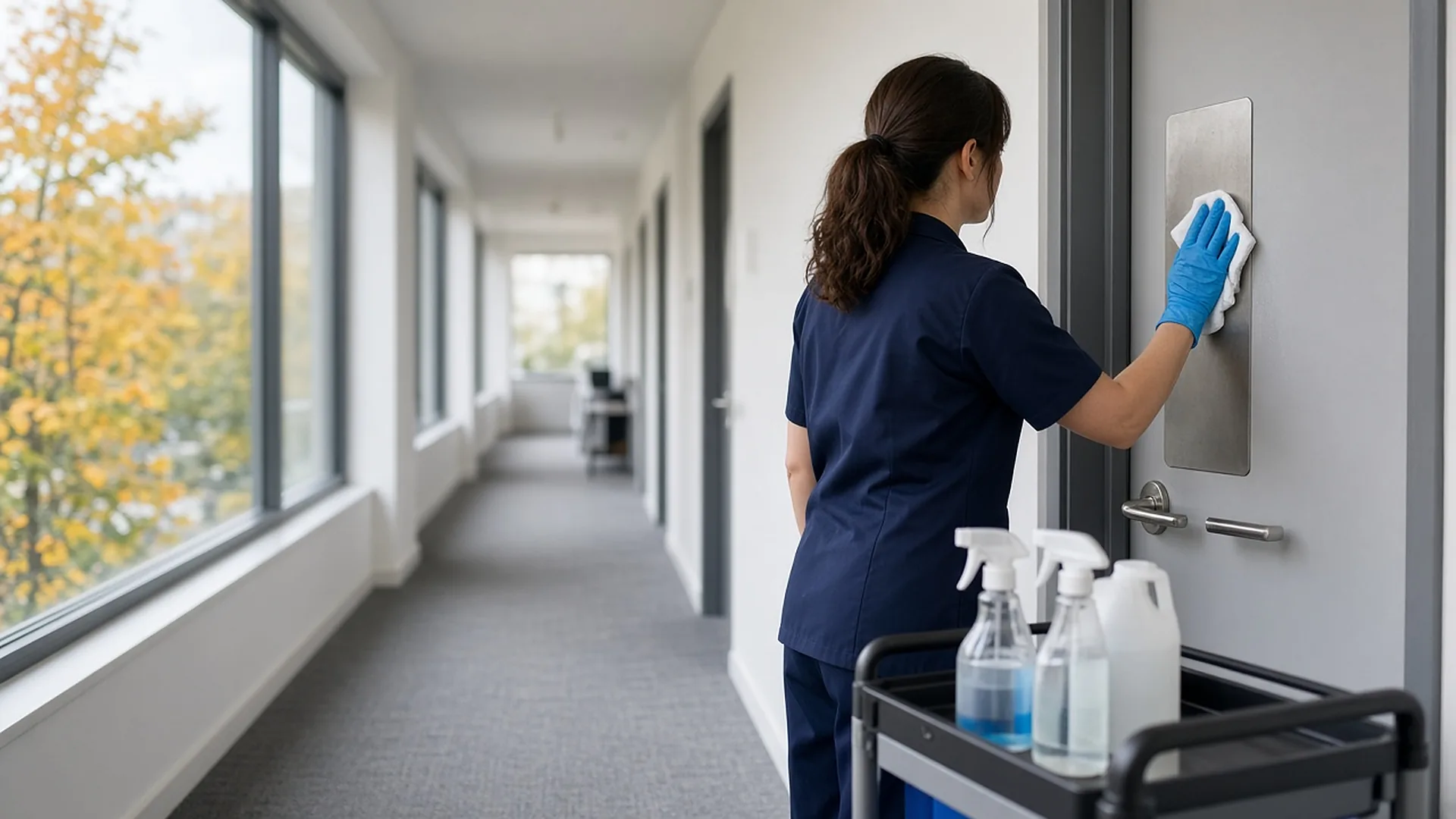
✓Touchpoints: add desk fans, blind cords, air-conditioning controls and meeting-room remotes to the high-touch list.
✓People: schedule heavy work such as machine scrubbing and kitchen degreasing for the coolest part of the day; provide water and rest breaks for cleaning operatives.
On a contract site, these changes can usually be made within your existing hours by moving tasks rather than adding them. A good partner will flag this before the season starts. If your daily specification hasn’t been reviewed since last summer, our day-to-day office cleaning teams can help you add seasonal triggers to it.
What about staff canteens and commercial kitchens?
Kitchens are where heat and hygiene meet most directly. Ambient temperatures behind the pass can be well above the rest of the building, extraction systems work harder, and grease softens and spreads. Three priorities stand out:
Temperature control: check that refrigeration is coping. Units that sit near ovens or in sunny rooms may struggle to keep food at 5°C or below.
Extraction and grease: clogged filters reduce airflow, which makes kitchens hotter and raises fire risk. Summer is a sensible time to schedule a clean.
Pest pressure: flies and wasps increase in warm weather, so keep fly screens intact and food covered, and make sure bins and drains are cleaned regularly.
If your extraction canopy, ducting or high-level surfaces haven’t had a thorough kitchen deep clean since winter, book one before the peak of summer rather than during it.
How does heat affect absence and productivity?
Uncomfortable, unhygienic workplaces don’t only create a compliance risk. They also make illness and absence more likely. We looked at the link between cleanliness and sick leave in our UK commercial hygiene report. Heatwaves add pressure: people sleep badly, drink less than they should and share more surfaces. Keeping basic hygiene strong during hot spells is one of the cheapest ways to protect attendance over the summer.
How Prime Facility Services helps keep workplaces hygienic in hot weather
Prime Facility Services has more than 20 years’ experience looking after commercial and industrial premises. We are owner-managed, run from our Telford headquarters and Dudley office, and employ local people to serve sites across Shropshire, Staffordshire and the West Midlands. Our quality management system has carried ISO 9001 and ISO 14001 accreditation since 2010, alongside Safecontractor accreditation since 2013.
In a heatwave, the services below carry most of the hygiene load:
Cleaning plans tailored to each site, with flexible daily, weekly or monthly schedules. They cover high-touch areas and regular disinfection of desks, keyboards and door handles, backed by regular quality checks.
Deep cleaning of kitchen surfaces and equipment, including refrigerators and freezers, plus extraction filters, fans and canopies. A hygiene certificate is issued once the clean is complete.
DBS-checked teams who are trained and supervised, with digital cleaning audits and digital time and attendance tracking that show when each round took place.
UKHSA’s heat-health alert season runs from 1 June to 30 September; alerts are yellow, amber or red and are impact-based.
There is no legal maximum working temperature in the UK, but heat must be included in your risk assessment.
Chilled food must be kept at 8°C or below (5°C or below recommended); bacteria multiply fastest between 8°C and 63°C.
Warm water between 20°C and 45°C supports legionella, so flushing little-used outlets matters more in summer.
Agree a hot weather cleaning schedule now and switch it on at amber.
Frequently asked questions
When does the UK heat-health alert season start?
UKHSA’s core heat-health alerting season runs from 1 June to 30 September each year, although alerts can be issued outside these dates if forecasts require it.
Is there a legal maximum temperature for working in an office?
No. HSE says there is no law for a maximum working temperature. Employers must keep temperatures reasonable and assess heat as a risk. The guideline minimum is normally 16°C, or 13°C for physically demanding work.
What temperature should a workplace fridge be?
The Food Standards Agency recommends setting fridges to 5°C or below. In England, Wales and Northern Ireland, chilled food must legally be kept at 8°C or below.
Does hot weather increase legionella risk?
It can. HSE says water at 20–45°C suits legionella growth, and summer heat can warm cold-water pipework, particularly in quiet buildings. Flushing little-used outlets helps control the risk.
How often should touchpoints be cleaned during a heatwave?
There is no fixed legal frequency. As a rule of thumb, shared kitchen and water-point touchpoints should be cleaned several times a day during hot spells, and washrooms should get at least one extra check.
Should cleaners work different hours in a heatwave?
Where possible, schedule physically heavy tasks such as machine scrubbing or kitchen degreasing for the coolest part of the day. Make sure operatives have water and rest breaks, in line with HSE heat stress guidance.
Can a cleaning contractor change its schedule during a heatwave?
Yes. A contractor can add extra rounds of washrooms, kitchens and water points while a heat-health alert is in force. Prime Facility Services builds flexible schedules into its office cleaning plans, so these changes can be agreed in advance. Call 0800 566 8894 to set one up for your site.
Winter Norovirus and Flu: How to Prevent Outbreaks in the Workplace
Last winter, norovirus reports in England peaked at 627 a week in January, and flu took off in late October. Here’s how norovirus and flu spread at work, why hand gel isn’t enough, and the cleaning steps that make the biggest difference.
Daytime Cleaning and Energy Bills: Can Changing Your Cleaning Schedule Cut Building Costs?
Non-domestic electricity averaged 24.51p per kWh in Q2 2026, and lighting alone accounts for 15.5% of office electricity use. Moving cleaning into the working day can cut the hours a building runs. Here’s how to work out whether it adds up for you.
Void Turnaround Times: Why Every Day Empty Costs Housing Providers
The median social home in England now stands empty for 30 days between tenancies, up from an average of 21 days before the pandemic. Here’s what the latest government and regulator data says about void times, rent loss and demand, and where days can be won back.
National Standards of Healthcare Cleanliness 2025 Explained for GP Surgeries and Dental Practices
The National Standards of Healthcare Cleanliness 2025 replaced the 2021 version and apply to all healthcare organisations. Here’s what functional risk categories, audit target scores and star ratings mean for a GP surgery or dental practice.